Parametric Families
Lecture 2
1. Properties of Distributions
- We must start getting familiar with central tendency and uncertainty measures from
lecture1. - Hence, let us practice their computations with some in-class iClicker.

1.1. A Single Probability Mass Function
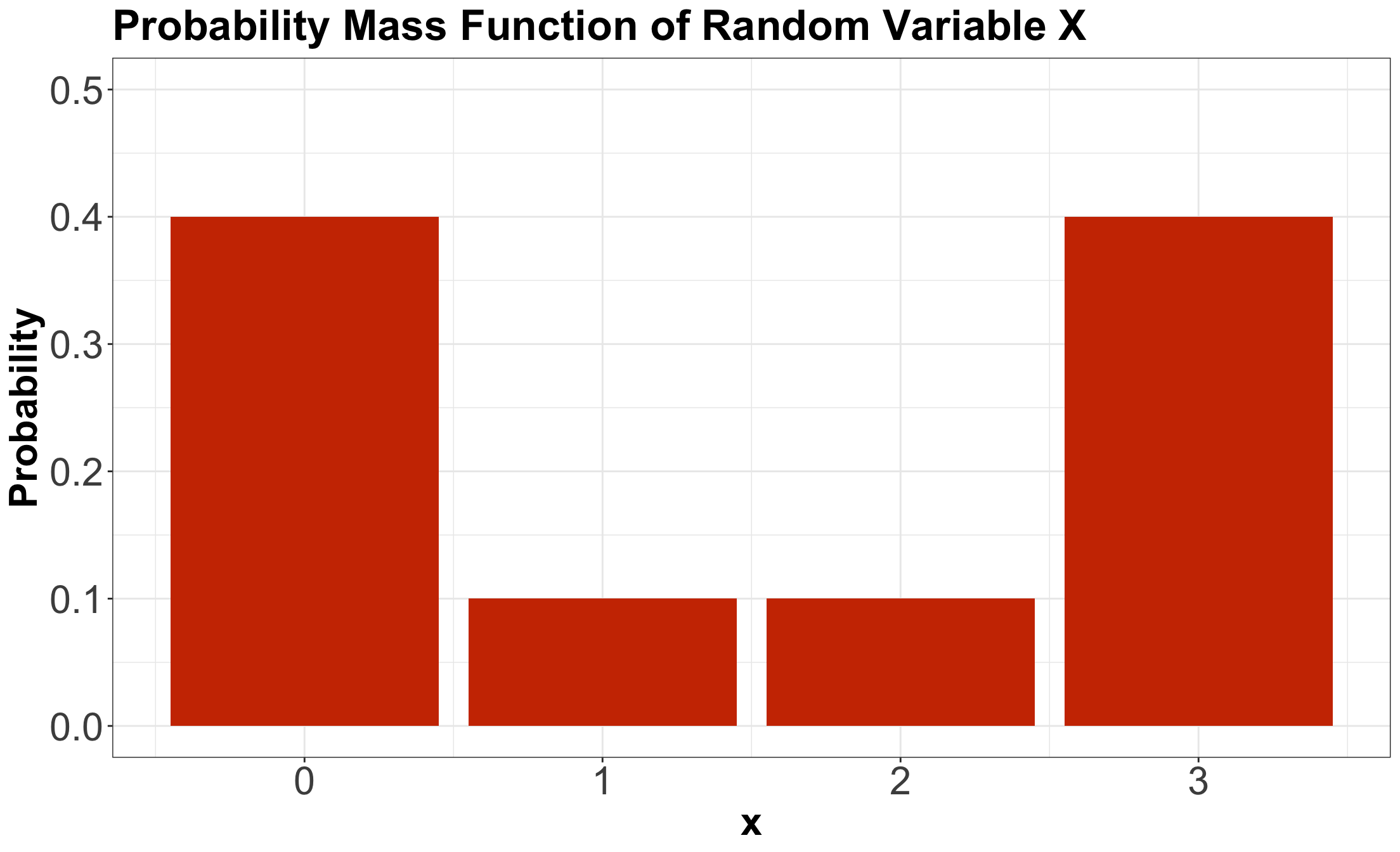
- Suppose \(X\) is a discrete random variable denoting the following: \[X = \text{Number of crabs found at a nest in a Mexican beach.}\]

Probability Mass Function (PMF)
| \(X\) | \(P(X = x)\) |
|---|---|
| 0 | 0.4 |
| 1 | 0.1 |
| 2 | 0.1 |
| 3 | 0.4 |
We plot it as a bar chart…
iClicker Question
Using the PMF for random variable \(X\), compute \(\mathbb{E}(X)\). Select the correct option:
A. 1
B. 1.5
C. 1.9
D. 6
iClicker Question
Using the PMF for random variable \(X\), compute the variance \(\text{Var}(X)\). Select the correct option:
A. 2.6
B. 1.85
C. 4.1
D. -1.85
iClicker Question
Using the PMF for random variable \(X\), obtain the mode \(\text{Mode}(X)\). Select the correct option:
A. 0
B. 3
C. Both 0 and 3
D. Neither
iClicker Question
Using the PMF for random variable \(X\), obtain the entropy \(H(X).\) Select the correct option:
A. -1.19
B. 0.52
C. -0.52
D. 1.19
Probability Mass Functions (PMFs)
iClicker Question
Answer TRUE or FALSE:
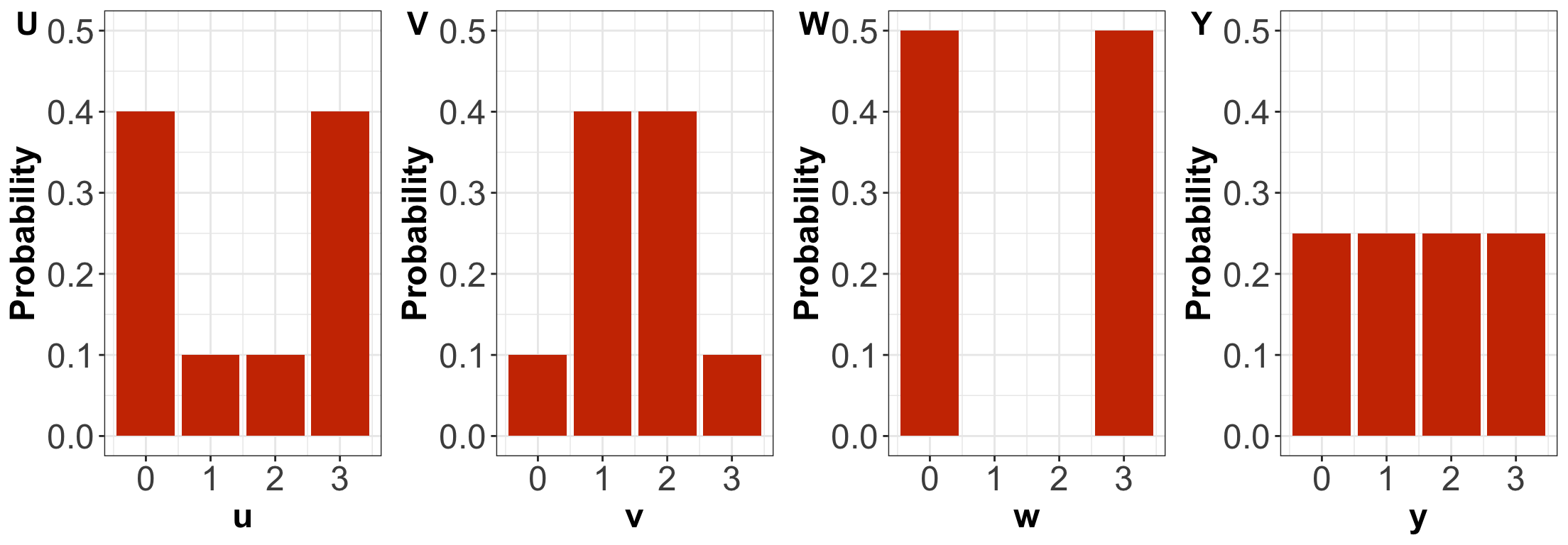
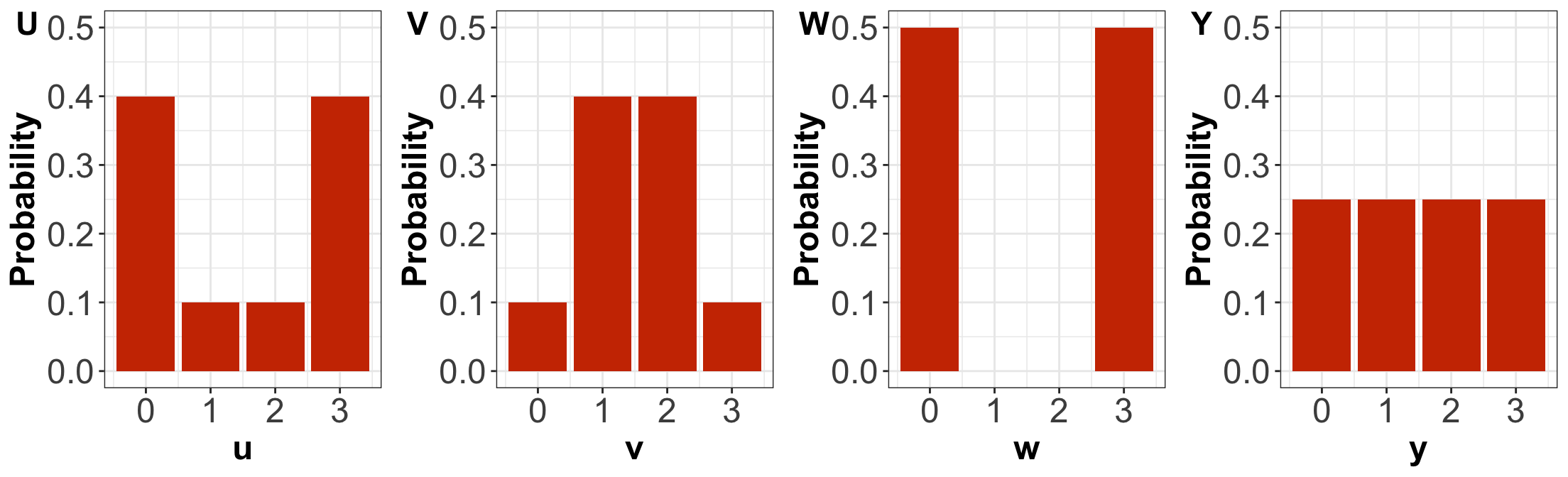
By only looking at the PMFs, \(U\) has higher entropy than \(V\).
A. TRUE
B. FALSE
iClicker Question
Answer TRUE or FALSE:
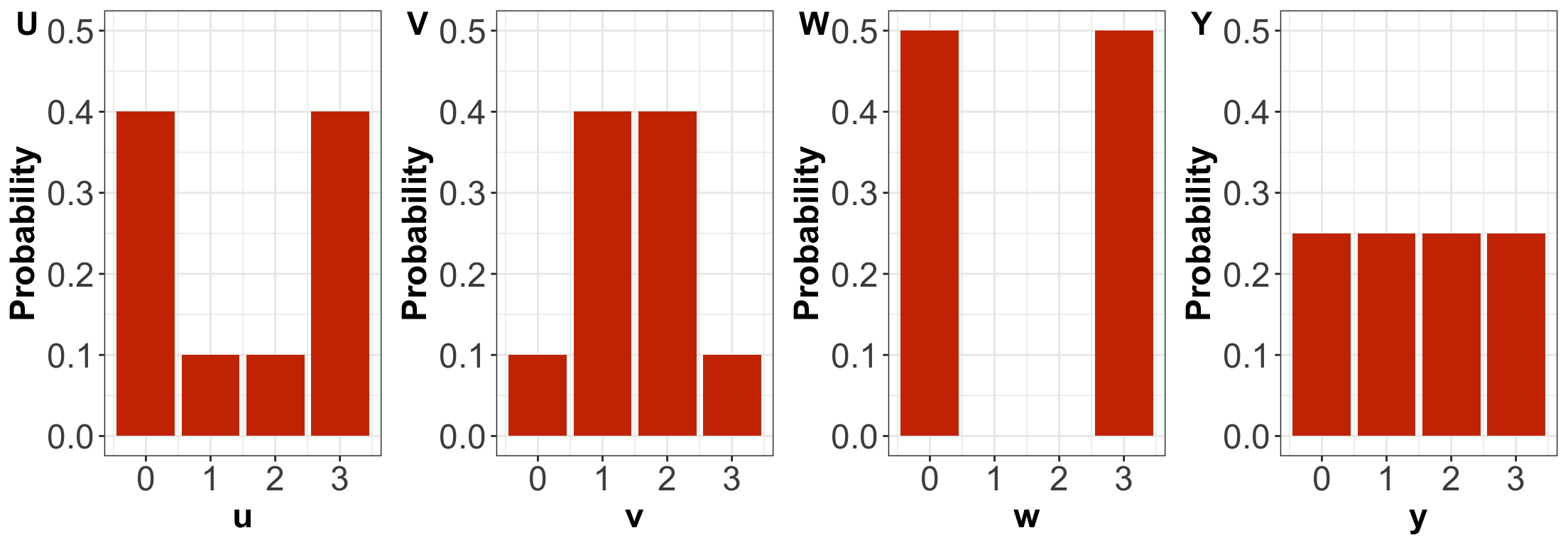
By only looking at the PMFs, \(U\) has higher variance than \(V\).
A. TRUE
B. FALSE
iClicker Question
Answer TRUE or FALSE:
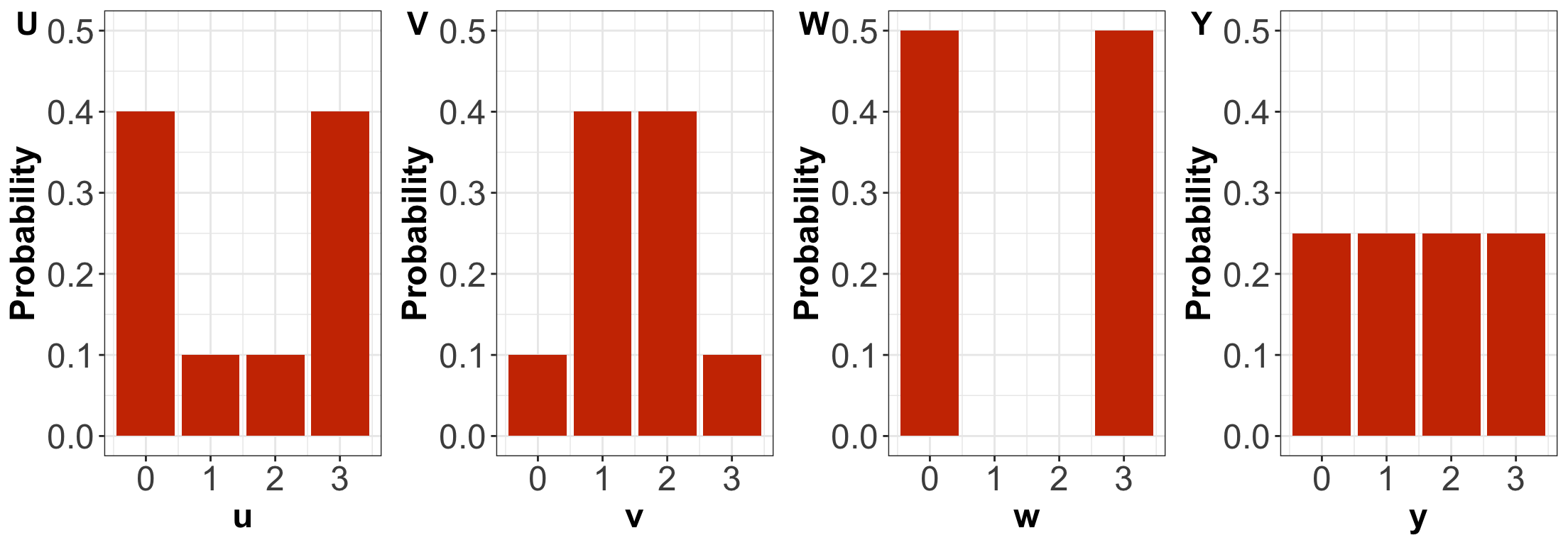
By only looking at the PMFs, \(W\) has the highest variance amongst the four distributions.
A. TRUE
B. FALSE
iClicker Question
Answer TRUE or FALSE:
By only looking at the PMFs, \(Y\) has the highest entropy amongst the four distributions.
A. TRUE
B. FALSE
Computing the Variance Using Crabs PMF for \(X\)
Method 1
\[\begin{align*} \text{Var}(X) &= \mathbb{E}\{[X - \mathbb{E}(X)]^2\} \\ &= \mathbb{E}[(X - 1.5)^2] \qquad \qquad \text{since } \mathbb{E}(X) = 1.5 \\ &= (-1.5)^2(0.4) + (-0.5)^2(0.1) + (0.5)^2(0.1) + (1.5)^2(0.4) \\ &= 1.85. \end{align*}\]
Now with the other approach…
Method 2
\[\begin{align*} \text{Var}(X) &= \mathbb{E}(X^2) - [\mathbb{E}(X)]^2 \\ &= \mathbb{E}(X^2) - (1.5)^2 \qquad \qquad \text{since } \mathbb{E}(X) = 1.5 \\ &= (0)^2(0.4) + (1)^2(0.1) + (2)^2(0.1) + (3)^2(0.4) - (1.5)^2 \\ &= 1.85. \end{align*}\]
2.2. Distribution Mapping
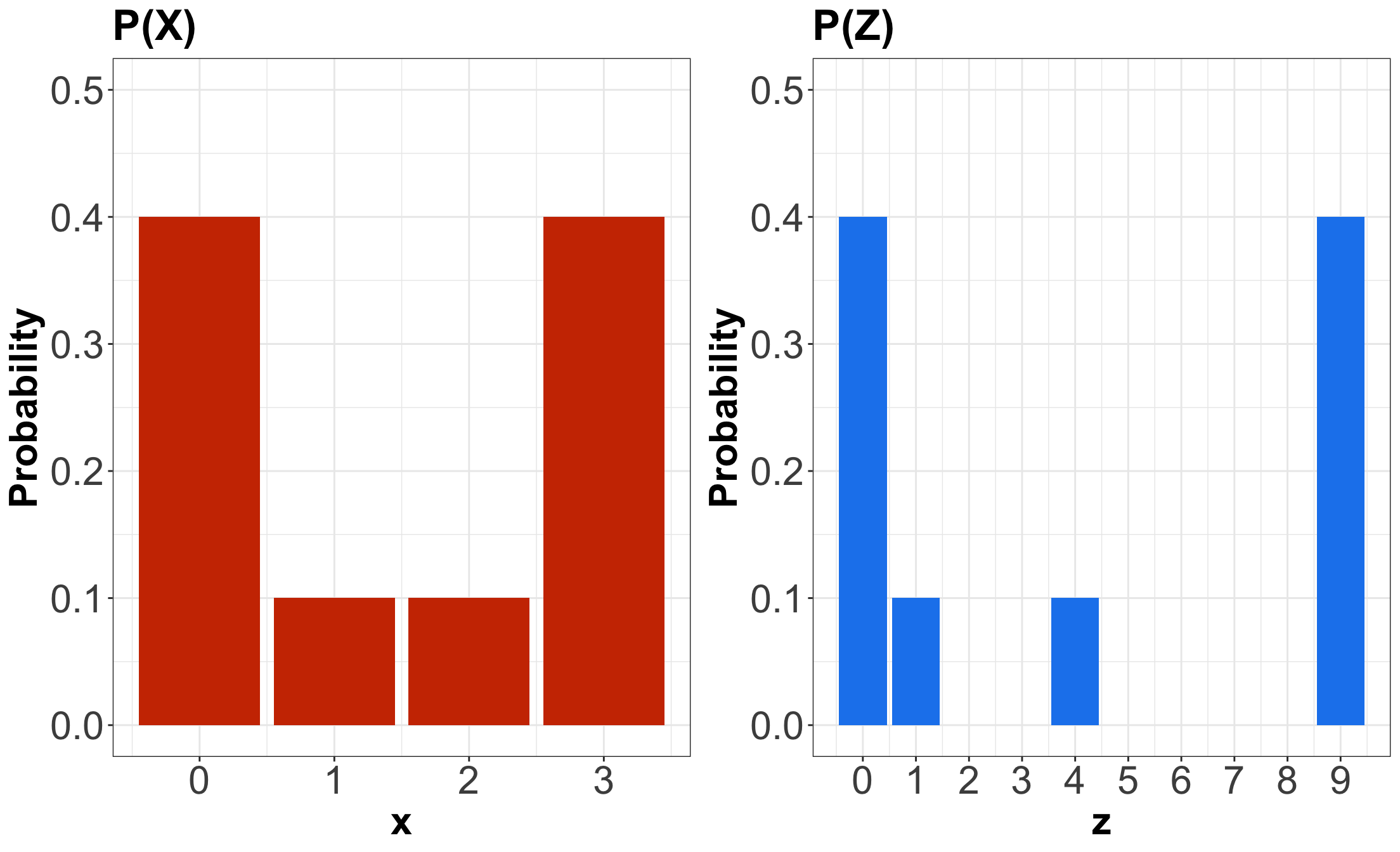
- Following up with the crabs PMF, let us focus the attention on \(\mathbb{E}(X^2)\).
- More specifically, what does \(X^2\) mean?
- It comes down to what we define in Statistics as a random variable transformation.
- We can rename \(X^2\) as \[Z = X^2.\]
Comparing PMFs
Caution

- The operator \(\mathbb{E}(\cdot)\) does not follow the usual algebraic rules.
- For instance, if no further assumptions are made for random variables \(X\) and \(Y\), then \[\mathbb{E}(XY) \neq \mathbb{E}(X)\mathbb{E}(Y).\]
- Moreover, note the following: \[\mathbb{E}(X^2) \neq [\mathbb{E}(X)]^2.\]
3.1. Bernoulli
- Suppose you play a game and win with probability \(0 \leq p \leq 1\).
- Let \(X\) be the outcome of this game. It is a binary random variable as follows \[ X = \begin{cases} 1 \; \; \; \; \text{if you win the game (success)},\\ 0 \; \; \; \; \mbox{otherwise}. \end{cases} \]
- The value \(1\) has a probability of \(p\), whereas the value \(0\) has a probability of \(1 - p\).
3.2. Binomial
- Suppose you play a game, and win with probability \(0 \leq p \leq 1\).
- Let \(X\) be the number of games you win within \(n\) independent games in total.
- \(X\) is said to have a Binomial distribution, written as \[X \sim \text{Binomial} (n, p).\]
3.3. Families Versus Distributions
- Specifying a value for both \(p\) and \(n\) results in a unique Binomial distribution.
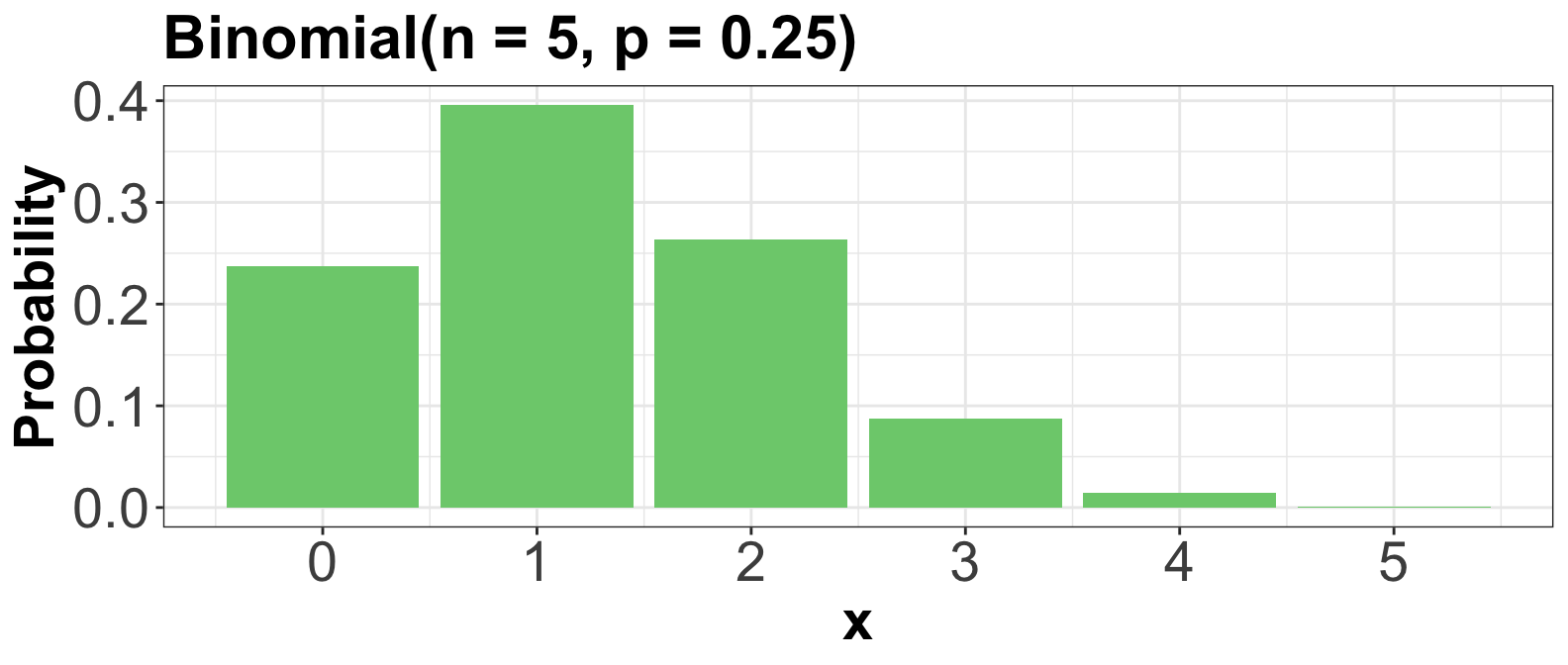
- There are, in fact, infinite Binomial distributions.
3.4. Parameters
- Since \(p\) and \(n\) fully specify a Binomial distribution, we call them parameters of the Binomial family.
- We call the Binomial family a parametric family of distributions.

4.1. Geometric
- Suppose you play a game, and win with probability \(0 \leq p \leq 1\).
- Let \(X\) be the number of independent failures before the first independent success.
- \(X\) is said to have a Geometric distribution, written as \[X \sim \text{Geometric} (p).\]
4.2. Negative Binomial (a.k.a. Pascal)
- Suppose you play a game, and win with probability \(0 \leq p \leq 1\).
- Let \(X\) be the number of independent losses at playing the game before experiencing \(k\) independent wins.
- \(X\) is said to have a Negative Binomial distribution, written as \[X \sim \text{Negative Binomial} (k, p).\]
4.3. Poisson
- Suppose customers independently arrive at a store at some average rate \(\lambda\).
- Then, the total number \(X\) of customers arriving after a pre-specified length of time follows a Poisson distribution: \[X \sim \text{Poisson} (\lambda).\]
4.5. Finally, let us check this mindmap…
](https://mermaid.live/edit#pako:eNp1U9tu2zAM_RVBTw7gpr608QVDH9pie9owbNgQDH5RZDolZkmGLlkyI_8-OUrXbo35IEg8FA_JI42UqxZoTQXKVrChkYRopWz0TeKOaWQWyOQj5AuTrRJh_31CNj0swvERDddgIZwmq2vkSkYdM6RjV_Zp8QLdo2T6MBfaIocr-0u9ujDZOK4JGsKIcZyDMURp8m6jr-86hr3TcDz-Gz_Z4h60VK7vMXoBH5STdo7cGdDmAnMgBUNQBlZJrB9Aby7TolTCo9H_id6jNvZvB6yzcG5iTc5tXE74AZQAT8ijt6U9XwyJNtApDQT2A2gEyVFuJ6Bp7t6m_flcyQzrJ9gyizsgs_2sCexA2jO3nw0jHe6h9WPyre1YHwDVEYsCJsnMwPhlrT4rNMYrEaAHJS1Kp5yZk0q7HvRZqrDSmArQgmHrX_M4-Rpqn0BAQ2u_baFjrrcNbeTRhzJn1deD5LS22kFM3dD6p_6IbKuZoHXnxfXegUlaj3RP6zS7Wd7cplWySsukzPNkFdMDrbMqW2ZFlXtfucqKvDrG9LdSPkOyXBVZVqRJmme3VVkWRUyhRav0x_DhTv_uRPHjdGGq4_gH7PkJGw)