Before starting the Master of Data Science (MDS) program at UBC, I had been working as a civil engineer for a consulting firm in Vancouver. I soon realized that despite producing vast amounts of data, the civil engineering and construction industries have felt little influence from advancements in data science and machine learning. Having seen the capabilities of data science and machine learning implemented in other industries, it became apparent that the civil engineering and construction industries could benefit greatly through the implementation of these technologies.
Learning from real data
by Alexander Kleefeldt
For the past three months, I was on a team of UBC Master of Data Science (MDS) students working on our MDS capstone project. Our team developed a data science product to help the course creators on the Thinkific e-learning platform to improve their online courses. Unsurprisingly, working on the improvement of online learning was a great learning experience for ourselves. Therefore, to share some of my experiences, and as a reminder to my future self, in this post I will summarize the six most important lessons I learned during the project. But first, to give some context, I’ll quickly describe the client and the project.
Becoming a data scientist: My year-long hiatus from medical school
by Daniel Raff
In my second year of medical school, I decided to open an unfamiliar email entitled “UBC Centennial Symposium on Health Informatics”. What was Health Informatics? I had no idea, but I intended to find out. The symposium featured the UK’s National Health Service (NHS) and showcased their use of large population datasets. I was impressed with how the NHS uses data to improve care. I went into medicine because of a personal desire to help people one-on-one; applying data science to healthcare seemed to provide the opportunity to positively impact millions at a time, in addition to one at a time.
Our curriculum, Part 1: Computer science & machine learning
by Mike Gelbart
This is the first in what will hopefully become a series of posts on our curriculum for the Master of Data Science (MDS) program at UBC. Our program is structured as six four-week blocks, each containing four mini-courses, for a total of 24 mini-courses. Each of these mini-courses is about one third the size of a regular university course. The image below summarizes our current schedule:
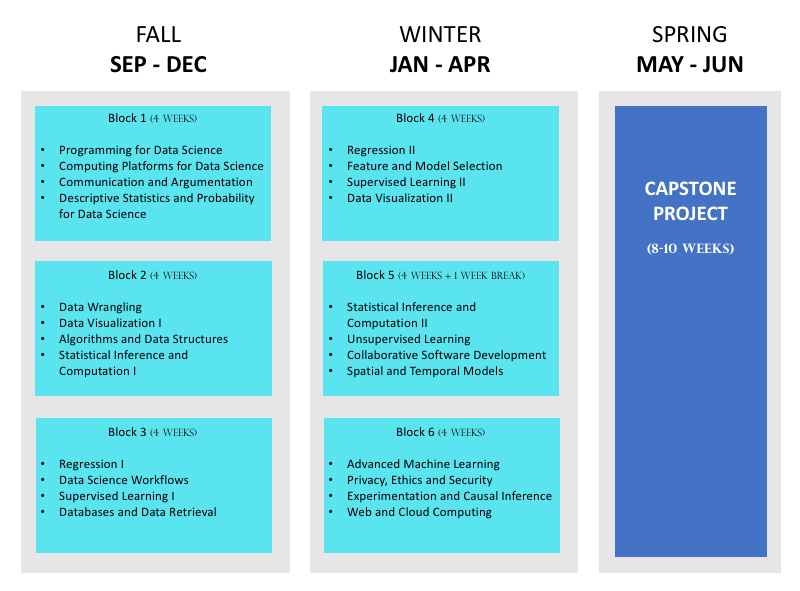
(For more details on each of these courses, see here.)
Visualizing massive open online courses
by Matthew Emery
After eight months of coursework, the UBC Master of Data Science (MDS) program concludes with a 2-month Capstone project. We partnered with Ido Roll from UBC’s Centre for Teaching, Learning and Technology (CTLT) to analyze data from UBC’s massive open online courses (MOOCs). UBC offers dozens of MOOCs to thousands of students through the edX platform. Unlike in-person classes, in a MOOC the instructor cannot observe student engagement directly. Instead, they must infer student engagement from recorded events (for example, a student pausing a video). A single course can involve millions of events in its lifetime, which means there was lots of data for us to look through. Our task was to build a dashboard to help MOOC instructors answer the following questions: