One of the most rewarding aspects of working on the UBC Master of Data Science program has been the close collaboration between my home department, computer science, and the statistics department here at UBC. The collaboration has also come with a challenge, though: the two communities often use different words to mean the same thing. A prime example would be the word “bias” – it is hard to get an unbiased opinion on what this word means! Over the last couple of years I recorded these discrepancies in a “statistics / machine learning dictionary” and also expanded the scope of the document to include general terminology issues that arise in data science. The current version of the document can be found here. As one highlight, I’ve found that all of the following terms can refer to the same thing: predictors, features, inputs, explanatory variables, regressors, covariates, and independent variables! In general, terminology is a tricky business because there aren’t always objective truths and yet people tend to feel quite passionate about it.
Communication in data science: more than just the final report
by David Laing
When people stress the importance of good communication in data science, they are usually saying something like what Hadley Wickham says in his book R for Data Science: “[It] doesn’t matter how great your analysis is unless you can explain it to others: you need to communicate your results.” In other words, good communication is crucial to data science because it is the final step, without which all prior work would be wasted.
Algorithms and optimization
by Mike Gelbart
Over the years I’ve struggled with the disconnect between “algorithms” — as a student might see in a standard algorithms and data structures class — and optimization. Several of the algorithms taught in such courses are in fact instances of (discrete) optimization: for example, dynamic programming (DP), or Dijkstra’s algorithm for finding the shortest path in a graph (related to DP), or greedy algorithms for solving the traveling salesman problem. I like the example of dynamic programming in particular because it can often form a conceptual island in students’ minds, without apparent connection to any of their other knowledge (for example, in the famous CLRS algorithms book, DP is listed under the miscellaneous heading “Advanced Design and Analysis Techniques”). In this post I’ll do a deep dive into one of our MDS assignments (or “labs” as we call them — but they’re really assignments) that attempts to connect these concepts using a single application. The lab is available here, as part of our publicly available teaching materials.
Introducing our 2017-18 cohort
by Mike Gelbart
This is an exciting time for the UBC MDS program, with the second cohort starting their journey in just a few days. We are thrilled about the strength and diversity of our incoming class. Here are some facts about the incoming cohort:
- 43 new students.
- 21 domestic, 22 international.
- 20 women and 23 men (47% women, 53% men).
- a variety of academic backgrounds, from psychology to civil engineering to a current UBC medical student who is taking a year out to pursue MDS.
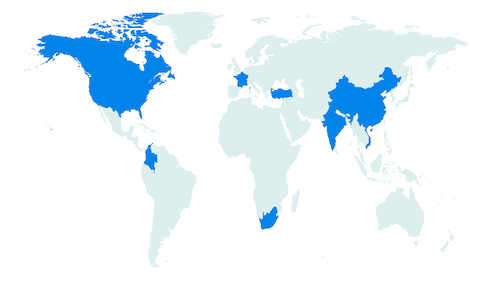
- previous degrees from UBC, other Canadian universities, the U.S., China, Colombia, France, India, South Africa, Turkey, and Vietnam (see map below).
Teaching with GitHub
by Mike Gelbart
In this post I will describe the system we use for delivering courses via GitHub in the UBC MDS program. I will first describe our high level goals and how we tackled them, and then discuss some implementation details. This post assumes the reader is familiar with git and GitHub and focuses more on the technical setup than the pedagogical implications.
Our main goals for this project were as follows:
- help students gain experience with version control systems
- eliminate all paper submissions
- facilitate peer review amongst the students
- facilitate group projects/assignments
- allow course staff to view and comment on work-in-progress remotely
- have a single place where most/all course content lives
When we were starting to think this through (around May 2016) there were already several existing solutions, such as GitHub Classroom, but none met all of our needs. We were committed to using GitHub rather than GitLab/Stash/etc because one of our team members, Jenny Bryan, had already been using GitHub to deliver STAT 545 and we wanted to build on her experience. The general approach is that students submit their work via GitHub and the TAs view/grade it there as well.