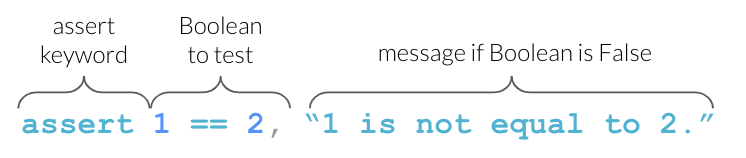
assert 1 == 1 , "1 is not equal to 1."
print('Will this line execute?')Will this line execute?How can we be so sure that the code we wrote is doing what we want it to?
Does our code work 100% of the time?
These questions can be answered by using something called units tests.
AssertionError: 1 is not equal to 2.

Detailed traceback:
File "<string>", line 1, in <module>AssertionError: 1 is not equal to 2.
Detailed traceback:
File "<string>", line 1, in <module>AssertionError:
Detailed traceback:
File "<string>", line 1, in <module>IndexError: list index out of range
Detailed traceback:
File "<string>", line 1, in <module>
File "<string>", line 2, in bad_functiondata = {'name': ['Cherry', 'Oak', 'Willow', 'Fir', 'Oak'],
'height': [15, 20, 10, 5, 10],
'diameter': [2, 5, 3, 10, 5],
'age': [0, 0, 0, 0, 0],
'flowering': [True, False, True, False, False]}
forest = pd.DataFrame.from_dict(data)
forest| name | height | diameter | age | flowering | |
|---|---|---|---|---|---|
| 0 | Cherry | 15 | 2 | 0 | True |
| 1 | Oak | 20 | 5 | 0 | False |
| 2 | Willow | 10 | 3 | 0 | True |
| 3 | Fir | 5 | 10 | 0 | False |
| 4 | Oak | 10 | 5 | 0 | False |
We use a systematic approach to design our function using a general set of steps to follow when writing programs.
1. Write the function stub: a function that does nothing but accepts all input parameters and returns the correct datatype.
2. Write tests to satisfy the design specifications.
def exponent_a_list(numerical_list, exponent=2):
return list()
assert type(exponent_a_list([1,2,4], 2)) == list, "output type not a list"
assert exponent_a_list([1, 2, 4, 7], 2) == [1, 4, 16, 49], "incorrect output for exponent = 2"
assert exponent_a_list([1, 2, 3], 3) == [1, 8, 27], "incorrect output for exponent = 3"AssertionError: incorrect output for exponent = 2
Detailed traceback:
File "<string>", line 1, in <module>3. Outline the program with pseudo-code.
def exponent_a_list(numerical_list, exponent=2):
# create a new empty list
# loop through all the elements in numerical_list
# for each element calculate element ** exponent
# append it to the new list
return list()
assert type(exponent_a_list([1,2,4], 2)) == list, "output type not a list"
assert exponent_a_list([1, 2, 4, 7], 2) == [1, 4, 16, 49], "incorrect output for exponent = 2"
assert exponent_a_list([1, 2, 3], 3) == [1, 8, 27], "incorrect output for exponent = 3"AssertionError: incorrect output for exponent = 2
Detailed traceback:
File "<string>", line 1, in <module>4. Write code and test frequently.
def exponent_a_list(numerical_list, exponent=2):
    new_exponent_list = list()

    for number in numerical_list:
        new_exponent_list.append(number ** exponent)

    return new_exponent_list
assert type(exponent_a_list([1,2,4], 2)) == list, "output type not a list"
assert exponent_a_list([1, 2, 4, 7], 2) == [1, 4, 16, 49], "incorrect output for exponent = 2"
assert exponent_a_list([1, 2, 3], 3) == [1, 8, 27], "incorrect output for exponent = 3"5. Write documentation.
def exponent_a_list(numerical_list, exponent=2):
    """ Creates a new list containing specified exponential values of the input list.

    Parameters
    ----------
    numerical_list : list
        The list from which to calculate exponential values from
    exponent : int or float, optional
        The exponent value (the default is 2, which implies the square).

    Returns
    -------
    new_exponent_list : list
        A new list containing the exponential value specified of each of
        the elements from the input list

    Examples
    --------
    >>> exponent_a_list([1, 2, 3, 4])
    [1, 4, 9, 16]
    """
    new_exponent_list = list()
    for number in numerical_list:
        new_exponent_list.append(number ** exponent)
    return new_exponent_list